An Assessment of the Effects of Urbanization on Nine Stream Ecosystems
Stream Ecosystems- Why are They Important?
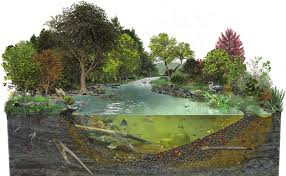
A healthy stream ecosystem provides considerable ecosystem services that benefits society as well as serves functions in natural processes. From recreation to provision, streams supply people with benefits such as aesthetic value and drinking water. Stream systems are connected downstream to larger water bodies, making their management essential with increasing urbanization.
A Roadtrip to Urban Streams
Starting in the west region of the country, there were three cities included in the assessment, with the western-most area being Portland, OR. Headed eastbound on Interstate-84, you’ll arrive eventually to Salt Lake City, UT. These two cities had predevelopment forested land, though have differing climates with Portland being warmer generally according to the research. Continuing east on I-80 until it intersects I-25, and if you then head southbound you’ll be in Denver, CO a cold-climate city whose land use history stems from agriculture.
Three additional metropolitans in the south along I-20 make up the next third of the sample areas- Dallas, Birmingham and Atlanta- all sharing respectively warm climates. Dallas is the only of these cities which has a traditionally agricultural land use before development, while the other were forested lands.
The final cities include Raleigh, NC; Boston, MA and Milwaukee, WI. Milwaukee and Boston share similar cold climates, though Milwaukee is the only of these cities to have tradtionally agricultural land use.
“Because of differences in climate, geology, topography, and historical land-use patterns, all of which define stream ecosystems, streams in different regions of the country respond differently to urban development. These environmental differences lead to variations in how hydrology, habitat, stream chemistry, and aquatic biota respond to urban development,” (USGS 6). Despite seemingly many regional variables other than urbanization’s affect on complex stream ecosystems, the assessment done was nationally consistent, with the biggest regional differences resulting from land-use history in each region.
Urbanization in America
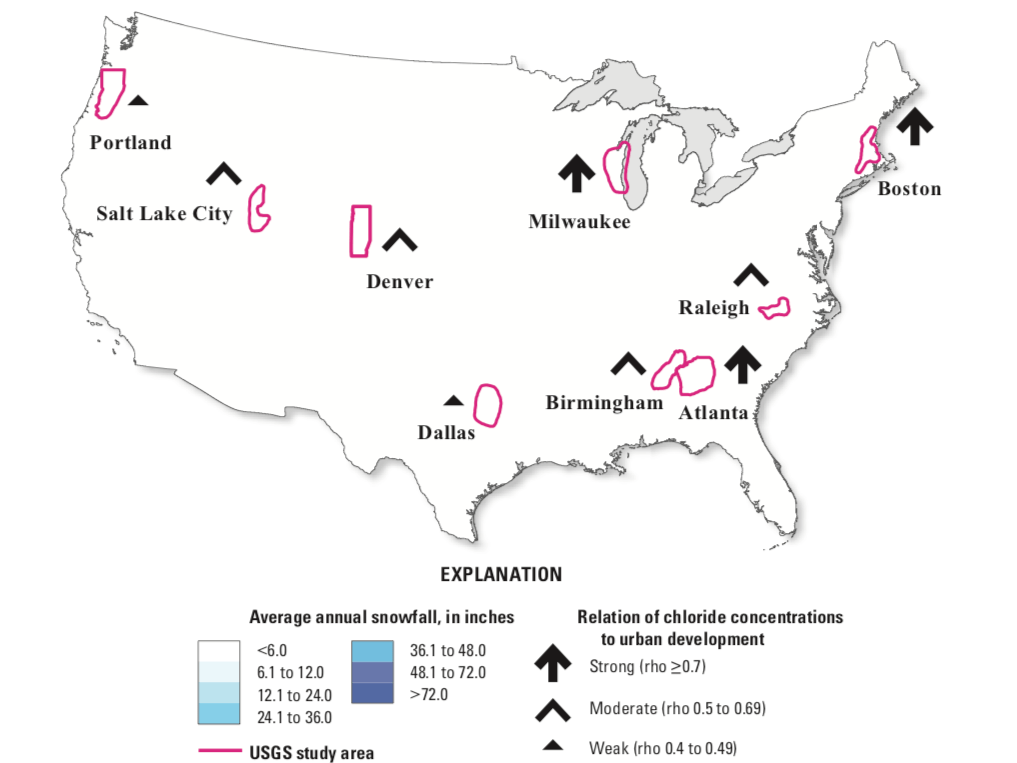
Today, four out of five Americans live in metropolitan areas, and the advantages and disadvantages associated with living in the city have been accentuated by industrialization and modernization. With growing populations in urban as opposed to rural areas, there needs to be more consideration for the impact that urban environments have on the natural world. An assessment by the United States Geological Survey (USGS) explored the effects of urbanization on nine different stream ecosystems across America, exploring stressors related to environmental degradation as well as demonstrate regional variation across the country on the quality of these streams. The above figure illustrates the study areas, and highlights the strength of concentrations of chloride in each respective location. (Chloride was observably increased at all areas, as opposed to other contaminants from urban development the research notes).
Hydrologic and Habitat Responses
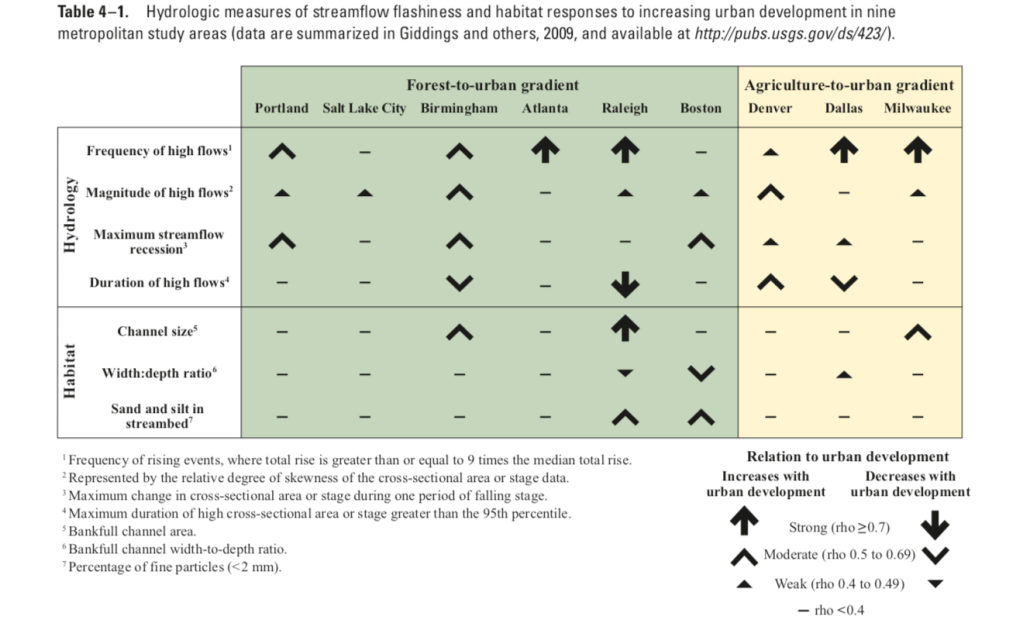
The most significant response of these ecosystems in the areas studied was an increase in the frequency and magnitude of high flows, which increased in the majority of the studied cities, regardless of the gradient of their environments, either forest-to-urban or agriculture-to-urban. The increase in flashiness of streams causes highly variable flows, due to less permeable surfaces that come with urbanization. Contrary to hydrological responses, habitat responses were concluded in this study to be inconsistent, due in part because “the habitat characteristics of a stream reach reflect a continually changing balance between the physical forces that drive changes in habitat, such as stream slope, streamflow, and sediment inputs, or loads, and the physical characteristics of the streambed and banks that resist these driving forces,” (USGS 41).
Chemical Responses
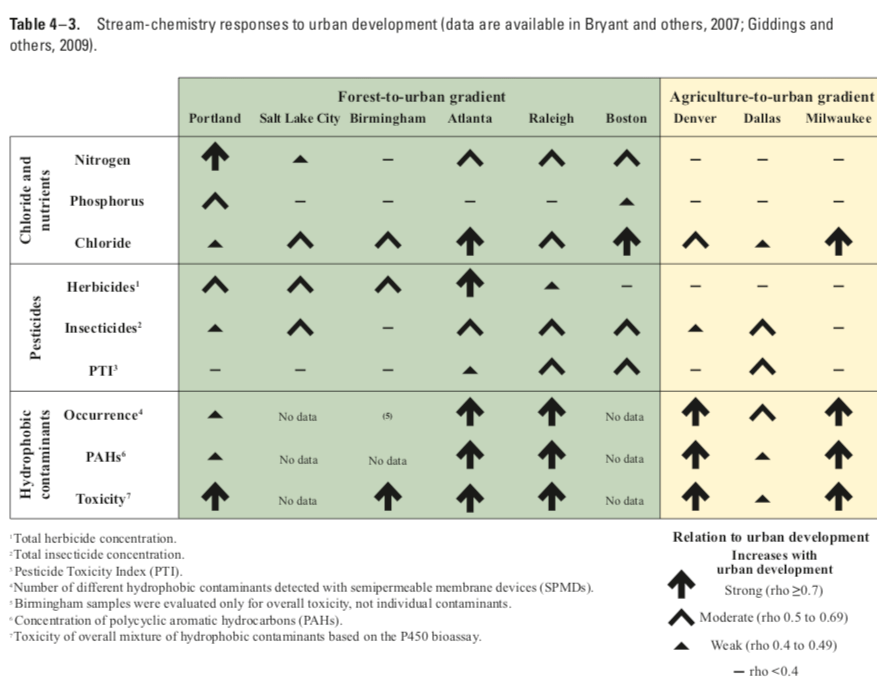
The research examined the influence of urbanization on stream chemistry, and found a general increase in three different types of contaminates: chlorides, pesticides and hydrophobic contaminants. Along with measurable increases in concentrations and toxicity, land-use history of the regions played a factor into the responses of the stream chemistry of the respective regions. Regions that were agricultural land that was developed generally had less response than those from forested land. Although these factors increased, few exceeded benchmarks harmful for life, though some pesticides pose threats to aquatic biota in higher concentrations.
Biological Responses
“The most consistent change in any of the biological communities was the loss of sensitive invertebrate species and a shift to species that are more tolerant to physical and chemical stressors,”(USGS 4). Generally, across the sites sampled, at least one of the subcategories of biological communities (algae, invertebrates and fish) experienced either a moderate or strong impact from urban development. This also follows the trend in the research which is that urbanization is more impactful in forested land gradients since they are not exposed to the land use change that agriculture land is.
Implications
One of the major findings of this assessment was that there is not one specific factor related urbanization’s affect on biological communities or stream functions, rather there are climate, topography and land-use influences also to consider when determining the severity of development on natural systems. Collectively, this assessment’s exploration of physical, chemical and biological analysis has shown a negative correlation between stream health and urbanization, considerably more so with areas that had pre-development forested land use as opposed to agriculture. For management, this research emphasizes that it is necessary to consider regional environmental variations, especially in regard to land use patterns. Another important aspect mentioned is to increase the perviousness of urban surfaces, as that has huge impacts on stream flows and other ecosystem relations.
Follow My Blog
Get new content delivered directly to your inbox.
 The Quality of our Nation's Waters